The State of Global Cybersecurity in 2026: A Year of Hybrid Warfare, Critical Infrastructure Breaches, and Mass Data Exposures

As the final quarter of 2026 unfolds, it has become indisputably clear that cybersecurity is no longer a background IT concern, but a front-and-center pillar of global geopolitics, economic stability, and public safety. While persistent societal inequalities, worsening climate disruptions, and lingering biosecurity threats continue to dominate headlines, a deeper digital current runs beneath them all. Modern conflicts are increasingly fought on digital frontiers just as much as physical ones. Governments weaponize citizens’ data against them, sophisticated botnets quietly undermine democratic processes, nation-state hackers target civilian critical infrastructure, and aggressive ransomware cartels hold major corporations hostage for astronomical payouts. As attacks grow bolder, more destructive, and increasingly difficult to contain, a comprehensive review of the year’s most damaging breaches reveals critical vulnerabilities across both the public and private sectors.
The Federal Data Lapses and the DOGE Fallout
More than a year after operatives associated with the Department of Government Efficiency (DOGE)—led by Elon Musk—swept through federal agencies to enact sweeping structural overhauls, the long-term ramifications of their data handling practices continue to emerge through federal court filings and whistleblower reports.
The most alarming incident centers on the Social Security Administration (SSA). According to a federal whistleblower, DOGE personnel uploaded a live copy of the Social Security database containing the personal identification numbers and sensitive records of most living Americans onto an unsecured third-party server. Although ongoing federal lawsuits seek to establish the precise extent of the exposure, court documents reveal that the SSA cannot definitively account for all data stored on the external server.
The agency acknowledged that DOGE entered into an agreement with an outside political advocacy group under the stated premise of uncovering voter fraud—claims that have repeatedly been made by executive leadership without empirical evidence. Leading House Democrats investigating the matter have characterized the exposure as potentially the largest data breach in U.S. national security history, raising profound concerns about the potential misuse of citizens’ personal information for politically motivated targeting.

Escalating Attacks on Critical Infrastructure: Water Systems and Energy Grids
Civilian infrastructure has increasingly become a primary theater for hybrid warfare. Throughout late 2025 and 2026, a series of calculated cyberattacks struck European and North American utilities, risking catastrophic real-world harm.
In Europe, operations attributed to Russian state-backed actors targeted energy and water supplies. Poland’s energy grid was targeted by wiper malware designed to systematically destroy computer systems, while a Swedish thermal plant and a Norwegian dam faced similar disruptions, the latter resulting in the uncontrolled spillage of massive volumes of water. By mid-2026, these threats expanded to Polish water treatment facilities.
Concurrently, geopolitical tensions involving the United States, Israel, and Iran prompted Iranian state-linked hacking groups to pivot toward opportunistic attacks on U.S. critical infrastructure. According to the Cybersecurity and Infrastructure Security Agency (CISA), Iranian actors targeted over 100 U.S. water systems during the summer months. Privately owned water utilities proved particularly vulnerable due to chronic funding shortages and insufficient baseline cybersecurity defenses, highlighting systemic weaknesses in municipal resource management.
Supply Chain Vulnerabilities and Third-Party Risk
The software supply chain remained a primary vector for widespread compromise in 2026, as overlapping attacks targeted open-source developers and downstream enterprise networks. Prominent security tools and open-source projects—including Aqua Security’s Trivy scanner, Bitwarden CLI, and Checkmarx—were systematically backdoored. These compromises enabled attackers to harvest administrative credentials and authentication tokens from developer workstations.

The resulting downstream breaches affected major organizations, including OpenAI and Vercel, while the European Union’s premier cybersecurity agency confirmed a substantial data heist stemming from stolen cloud authentication keys. The scope of these supply chain operations prompted international law enforcement cooperation, culminating in the August arrest of two suspects in Australia linked to the campaigns.
Meanwhile, enterprise service providers experienced compounding vulnerabilities. Market research provider Klue suffered a catastrophic breach executed by the Icarus extortion gang, which utilized an un-decommissioned API credential issued during a 2022 pilot program. The breach exposed cloud service keys belonging to approximately 200 corporate clients, including cybersecurity leaders Jamf, HackerOne, and LastPass. Despite official guidance advising against ransom payments, Klue reportedly reached an agreement with the hackers to prevent the publication of stolen data, only to discover that a secondary threat actor had also acquired portions of the compromised data store.
Law Enforcement and Intelligence Systems Breached
Federal law enforcement agencies experienced unprecedented compromises of sensitive investigative architecture. In April, the U.S. Federal Bureau of Investigation formally declared a "major cyber incident" after discovering an unauthorized intrusion into an unclassified surveillance network. The breach reportedly compromised sensitive communication intercept data, including wiretap logs and the phone numbers of targets under active federal surveillance. Because the incident necessitated formal congressional notification under strict legal thresholds, federal officials indicated the breach caused demonstrable harm to national security. Suspicions quickly fell on Chinese state-sponsored actors.
Months later, in August, the Bureau of Alcohol, Tobacco, Firearms and Explosives (ATF) confirmed its own major congressional disclosure following a ransomware attack targeting internal systems that housed details concerning active agency investigations.
Massive Identity and Healthcare Data Exposures

The commercial aggregation of identity documents resulted in historic data spills throughout the year. An extensive breach at identity verification firm IDScan exposed the personal credentials of approximately 150 million individuals across the United States and Canada, with stolen records surfacing on dark web search engines. This incident compounded a series of similar exposures across various sectors, including a hotel check-in platform, a Canadian money transfer application, a prison payphone service provider, and a U.K. visa processing portal. Collectively, these lapses exposed millions of sensitive identity documents—such as passports and driver’s licenses—due to basic security omissions.
Industry analysts note that these continuous breaches severely undermine the integrity of "know your customer" (KYC) protocols and mandatory government age-verification frameworks, as stolen credentials can be easily recycled to bypass digital security barriers.
Concurrently, the healthcare sector faced debilitating intrusions impacting tens of millions of patients. Insurance provider DentaQuest suffered the year’s largest healthcare breach, compromising the medical records of 15 million individuals. Similar incidents at electronic record host CareCloud and billing giant Aesto Health exposed the sensitive health data of millions more across dozens of clinical practices.
Corporate Disruption: Hasbro, Instructure, and Medical Device Manufacturers
Major corporations struggled extensively to maintain operations amid coordinated extortion campaigns. Toy manufacturer Hasbro experienced weeks of complete operational downtime following a late March cyberattack. The disruption forced the company to delay its quarterly filing with the U.S. Securities and Exchange Commission (SEC), illustrating the severe financial and administrative tolls exacted by prolonged network outages.
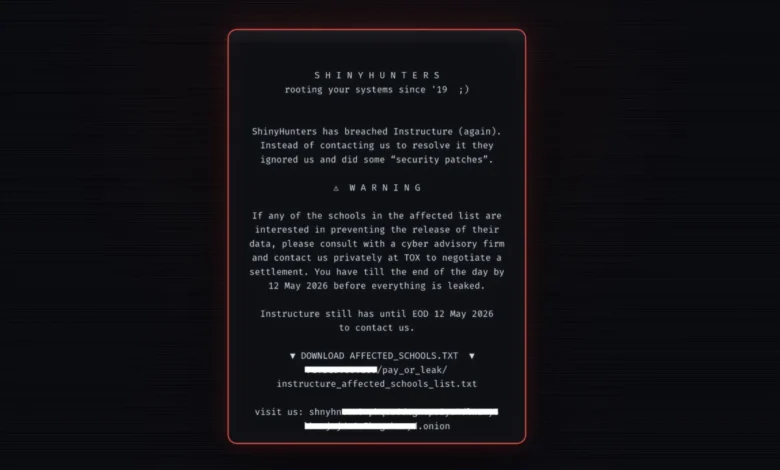
Education technology giant Instructure faced a disruptive campaign led by the ShinyHunters gang, which utilized sophisticated voice-phishing techniques to compromise internal credentials. After gaining access to the Canvas learning management system—which serves over 30 million students and staff—the hackers demanded a ransom. When payment was initially withheld, the actors defaced platform login portals during nationwide final examinations, disrupting academic schedules across the United States. Despite direct advisories from the FBI against yielding to extortion, Instructure ultimately complied with the ransom demands. ShinyHunters similarly targeted major telecommunications and travel enterprises, including Charter Communications and Carnival Cruise Line.

In the medical technology sector, destructive cyberattacks marked a tactical evolution for state-sponsored actors. In March, Iranian hacktivist collective Handala breached U.S. medical device manufacturer Stryker, remotely wiping tens of thousands of employee devices and severely impacting first-quarter earnings. A comparable disruption struck Boston Scientific in August, cutting off the global network of the pacemaker manufacturer, delaying critical product shipments, and prompting a multi-week operational recovery that extended deep into September.
Implications for the Future of Digital Security
The breadth and severity of the 2026 cyber incident landscape underscore an urgent need for structural reform across both public governance and private enterprise. As threat actors increasingly leverage automated tools, supply chain dependencies, and artificial intelligence integration against foundational systems, traditional defensive postures have proven insufficient. Policymakers, industry leaders, and cybersecurity frameworks must evolve rapidly to establish stricter accountability, mandatory baseline security standards, and resilient infrastructure architectures if global digital stability is to be preserved in the years ahead.
Related posts: